Booking engine for hotels & stays
Ghatmatha Stays
A direct-booking engine for eight Konkan and ghat stays
Ghatmatha Stays is a sample brief. We imagined a small collection of eight independent stays between the Western Ghats and the Konkan coast, whose guests booked through apps that hid the drive, the GST and the people running the houses, and asked ourselves what we'd build for them. The stays are imaginary. The booking engine isn't: we designed and engineered it, and you can use it right now, below.
- IndustryHotels & stays
- Year2026
- Runs onWeb
- DisciplineWebsites & web apps
- Built aroundRazorpay, UPI, RuPay and card networks, Netbanking, WhatsApp Business API, GST e-invoicing, Google Maps
A sample brief, a real product. We wrote this brief ourselves. The business is imaginary; the product is not: we designed and engineered it, and you can use it below. We publish results only for work a client has let us verify, so this page shows none.
The brief
We imagined Ghatmatha Stays as a small Mumbai team that books eight independent houses for their owners: a plantation bungalow in Sawantwadi, laterite cottages on a cliff near Dapoli, a forest lodge in Amboli, a restored house in Aldona, a lake camp at Bhandardara, a villa near Alibag, a hill bungalow in Panchgani and an orchard farmhouse in Devgad.
Their guests are families and couples from Mumbai and Pune planning weekends on their phones. They compare on price, drive time, pools, pets and monsoon views, want to pay part now, and often need a GST invoice because the trip is an offsite.
- Eight stays across the Konkan coast, the ghats and Goa
- Guests mostly from Mumbai and Pune, booking on phones
- Weekend, weekday and festival-peak pricing
- Company stays that need a proper GST invoice
The problem
A collection like this lives or dies by the drive. A cottage that looks close on a listing app can be ten hours away over a ghat road, and none of the apps make that the first thing you see. Prices are shown without tax until the last step, and the GST slab changes from night to night when a weekend rate crosses ₹7,500.
Small houses also can't take every booking in full up front, and they can't afford a cancellation policy that nobody understands. Guests need to know what they'll get back, today, if plans change.
- Distance is the real decision, and it is usually hidden
- GST on rooms depends on each night's value
- Part-payment and pay-at-property vary by house
- Refunds depend on timing and the rate chosen
The approach
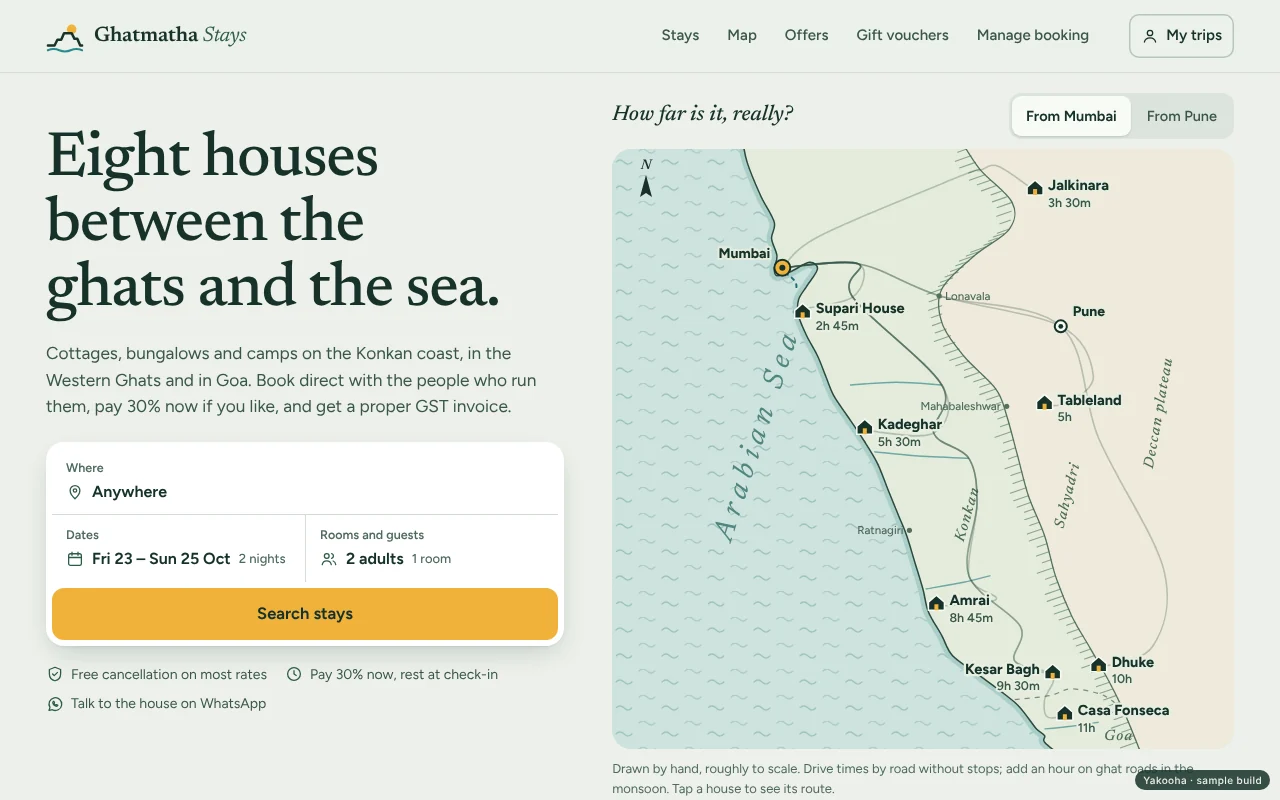
We made the map the front door. The home page is a hand-drawn strip of the coast and the Sahyadri scarp with every stay plotted and its route traced from Mumbai or Pune, so the first question gets answered before the search panel does. Everything else is quiet: one illustration style for every place and room, and a calm, money-first booking flow.
Behind it we built one pricing engine that every page shares. The calendar, the results, the room table, the booking summary, the invoice and the manage-booking screens all ask it the same question, so a weekend night, a Diwali night, a coupon or an extra bed costs the same wherever you see it.
- A route map with drive times as the main comparison
- Prices that say nightly or total, before or after GST
- GST split per room per night into its two slabs
- Pay-later options shown, and explained when they don't apply
- Refunds shown as an amount and a deadline, not a policy name
What shipped
- Search by region or stay on a calendar that shows the lowest nightly price, peak Diwali and New Year nights, and full days
- Pick rooms and guests with children's ages, priced by under-6, 6–11 and 12+ rules
- Compare stays on a hand-drawn route map with live drive times from Mumbai or Pune
- Filter by price, drive time, pool, pets, free cancellation, type, amenities and rating; switch nightly and total prices; see sold-out stays with the next free dates
- Choose a room and rate plan: room only, breakfast or all meals, refundable or non-refundable, against live availability
- Book with a GSTIN check-digit validator, coupons and gift vouchers, and GST worked out per room per night at the lower or higher slab
- Pay in full, a deposit now or everything at the property through a simulated UPI, card and netbanking checkout, including a failed-payment path
- Download a GST invoice and an .ics file, share on WhatsApp and get directions from the confirmation
- Change dates, add a room, change meals or cancel, with the difference or refund computed from the policy and the clock
- Sign in to My trips by phone OTP or with a sample account that has upcoming, past and cancelled stays
Under the surface
How it is built
In production we'd ship this on Next.js with a separate Node inventory and rates service on PostgreSQL. Availability would be stored as booked intervals per room type and queried with an interval tree, so a date change or an extra room is a single overlap check. Rates would be rules (weekday, weekend, peak, season, meal plan, refundability) evaluated per night, and the same quote object would drive the UI, Razorpay orders with part-payments, WhatsApp Business confirmations and GST e-invoices through the IRP. A channel manager keeps each house's calendar in step with the apps they already sell on.
- One quote function shared by search, booking, invoice and changes
- Holds placed on rooms during checkout and released on failure or cancellation
- GSTIN validated by format and check digit before the invoice is raised
- Cancellation refunds computed from tier deadlines at the moment of cancelling
- Place of supply fixed to the property's state, so invoices carry CGST and SGST
Considered and turned down
We considered a white-label hotel booking widget embedded in a marketing site. We turned it down because none we looked at could put drive time at the centre, price GST per night, or offer pay-at-property house by house, and the brand would have stopped at the widget's edge.