Mobile app for restaurants & food
Dabba Daily
A tiffin subscription app for Mumbai office lunches
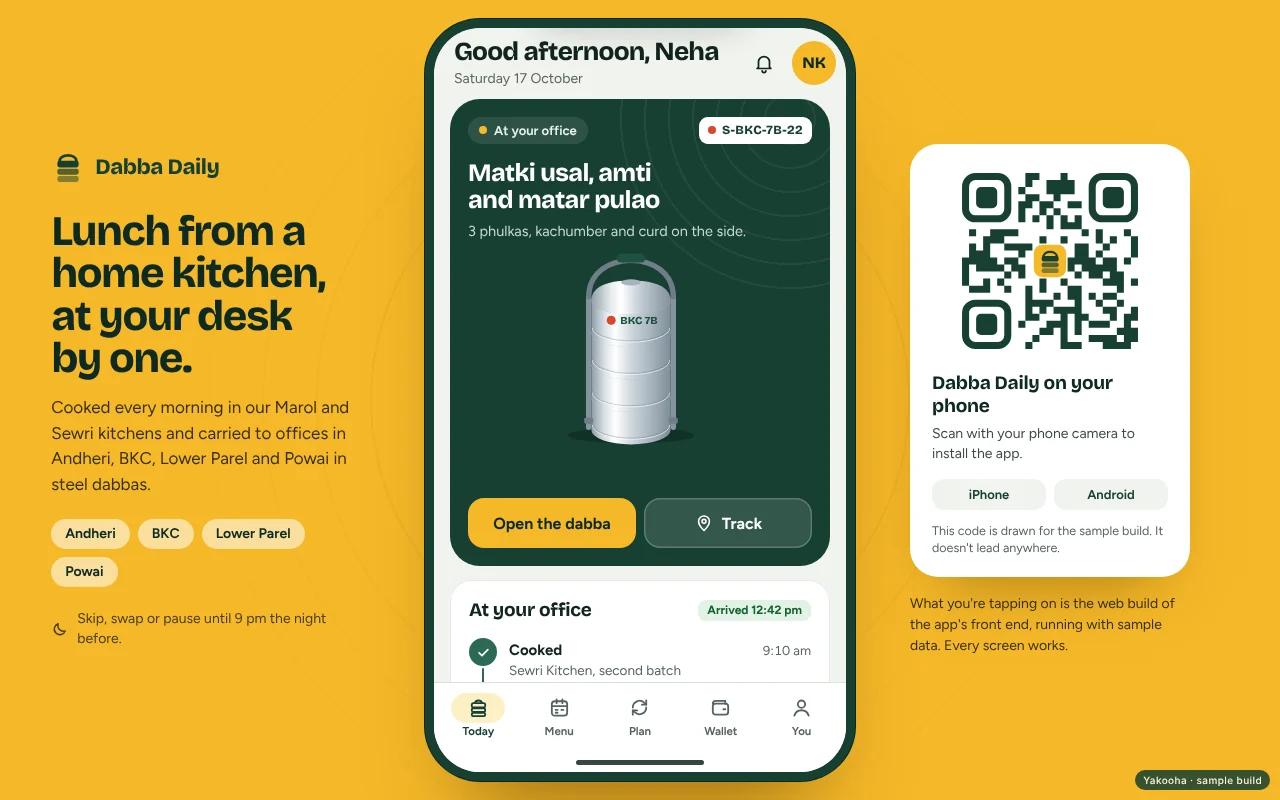
Dabba Daily is a sample brief. We imagined a tiffin service cooking home-style lunches in two Mumbai kitchens and carrying them in steel dabbas to offices in Andheri, BKC, Lower Parel and Powai, and asked ourselves what app we'd build for the people eating them. The business is imaginary. The app isn't: we designed and engineered it for iOS and Android, and what you can use right now, below, is the web build of its front end.
- IndustryRestaurants & food
- Year2026
- Runs oniOS, Android
- DisciplineMobile apps
- Built aroundRazorpay, UPI AutoPay (recurring mandates), WhatsApp Business API, Firebase Cloud Messaging, Masked calling, GST invoicing
A sample brief, a real product. We wrote this brief ourselves. The business is imaginary; the product is not: we designed and engineered it, and you can use it below. We publish results only for work a client has let us verify, so this page shows none.
The brief
We imagined a tiffin service in Mumbai that cooks every morning in two central kitchens, one in Marol and one in Sewri, and delivers home-style lunch to office desks in Andheri, BKC, Lower Parel and Powai. Its customers are office workers who want food that tastes like home, on a weekly subscription, in a steel dabba that goes back to the kitchen the next day.
Their days are fixed by the 1 pm lunch break and the 9 pm cut-off the night before, when the kitchen locks its numbers for the morning.
- Two kitchens, four delivery areas, six days a week
- Veg, Jain, non-veg and high-protein plans
- Billed in 4-week cycles over UPI AutoPay
- Steel dabbas swapped on an office rack every day
The problem
A tiffin service like this usually runs on WhatsApp messages and a notebook. Customers can't see what's in tomorrow's dabba, skipping a day means texting someone before they sleep, and nobody is sure how a holiday or a week of travel affects the bill.
The kitchen, in turn, needs firm numbers by 9 pm, and refunds and GST invoices get worked out by hand at the end of the month.
- Menus shared as forwarded images
- Skips and pauses lost in chat threads
- Holidays and refunds handled case by case
- No record of where the dabba is before lunch
The approach
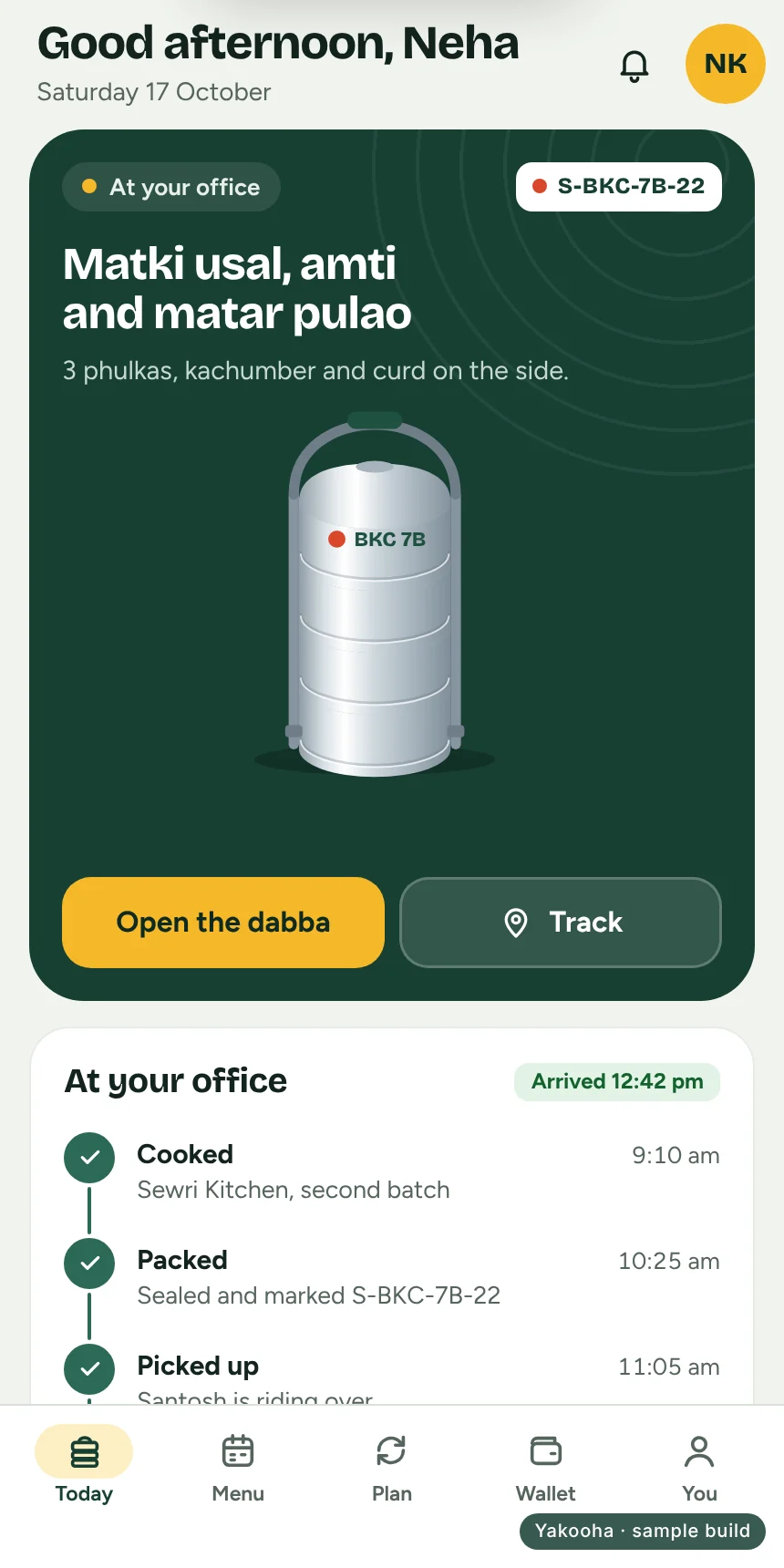
We made the app about one object: today's dabba. The Today screen opens on a drawn steel dabba that comes apart into its tiers when you tap it, with the morning's run underneath and tomorrow's dabba below that, open for changes until the cut-off. Every change states what happens to the money: a skip either adds a day to the cycle or credits the wallet, a pause moves the next AutoPay, and a cancellation shows its prorated refund line by line.
We designed it phone-first, with a tab bar, bottom sheets and large touch targets, and drew every food illustration in one flat steel-and-turmeric style. The browser demo is the web build of the app's front end; on a wide screen it sits in the middle of the page with a drawn sample install code beside it.
- One drawn dabba as the centre of the app
- The 9 pm cut-off shown as a live countdown on every change
- Holidays, Navratri and Diwali week built into the menu calendar
- Money shown with GST split, never as a surprise
- WhatsApp and masked calls as the human fallback
What shipped
- Open today's steel dabba and watch its run from Cooked to Packed to Picked up to At your office
- Skip or swap tomorrow's dabba until 9 pm the night before, with a live countdown
- Pause for travel; paused dabbas move to the end of the cycle and the AutoPay date shifts
- Browse veg, Jain, non-veg and high-protein menus for this week, next week and Diwali week
- Build a plan by food, days, rotis, rice and spice, with 5% GST split into CGST and SGST
- Approve a simulated UPI AutoPay mandate, change UPI ID, or cancel with a prorated refund
- Top up the wallet by UPI, QR, card or netbanking and download GST invoices
- Rate yesterday's dabba, add chaas or a sweet from the wallet, and chat with the kitchen desk
- Share a give-a-week, get-a-week code and hand off to WhatsApp
Under the surface
How it is built
In production this would be a React Native (Expo) app for iOS and Android, backed by a Node.js and PostgreSQL service that owns subscriptions, cycles and the kitchen plan. At 9 pm the service freezes the next day's counts per kitchen and per dish, and the rider app picks up routes and dabba codes from it. Payments run on Razorpay UPI AutoPay mandates with the RBI-required pre-debit notifications, order updates go out through Firebase Cloud Messaging and the WhatsApp Business API, and rider calls go through a masked-number bridge.
- Cut-off logic lives on the server in IST, so phones in any timezone agree
- Cycles, skips, pauses and refunds are one ledger, so invoices and refunds reconcile
- The kitchen plan is generated from locked orders, not from the app's view of them
- The rider app shares the dabba code and drop point, never the customer's number
Considered and turned down
We considered a plain WhatsApp ordering bot, which most tiffin services already use. We turned it down because subscriptions, cut-offs and AutoPay changes need a screen that shows state, and a chat thread can't show what tomorrow looks like at a glance.