Website for restaurants & food
Kokum & Coal
A restaurant site with direct ordering and table booking
Kokum & Coal is a sample brief. We imagined a family-run Malvani and Goan kitchen in Bandra West, with a second outlet in Thane, that was handing a slice of every lunch order to the delivery apps, and asked ourselves what we'd build for them. The restaurant is imaginary. The site isn't: we designed and engineered it, drew every plate on it, and you can order a fish thali from it right now, below.
- IndustryRestaurants & food
- Year2026
- Runs onWeb
- DisciplineWebsites & web apps
- Built aroundRazorpay, UPI, WhatsApp Business API, Petpooja, Porter, Google Maps
A sample brief, a real product. We wrote this brief ourselves. The business is imaginary; the product is not: we designed and engineered it, and you can use it below. We publish results only for work a client has let us verify, so this page shows none.
The brief
We imagined Kokum & Coal as a family restaurant that started as six tables in Bandra in 2011: a Malvani kitchen from one side of the family, a Goan charcoal grill from the other, and a second room in Thane for the regulars who moved out. Fish is bought each morning and priced by the day.
The people who come to its site are not browsing. A regular wants lunch at her desk in two taps, a family wants a Sunday table, an office admin wants a per-head number for forty, and a visitor searching for Malvani food in Bandra wants to know if this is the real thing.
- Two outlets with slightly different menus and prices
- Catch of the day sold at market price
- Lunch delivery within a few kilometres of each kitchen
- Family dining, private rooms and office catering
The problem
Restaurants like this tend to live on aggregator apps for ordering and on a phone line for bookings. The app owns the customer, takes a large commission and flattens a menu of market-priced fish, Jain options and thali customisations into a generic list.
Their own websites are usually a PDF menu and a phone number, so there is no good reason for a regular to order direct.
The approach
We decided the site should do the ordering properly rather than point elsewhere: real customisation, honest pincode limits, slots, a bill that shows GST and packaging line by line, and WhatsApp updates people already trust. The catch board changes through the day so the market-priced menu reads as a living thing, not a missing price.
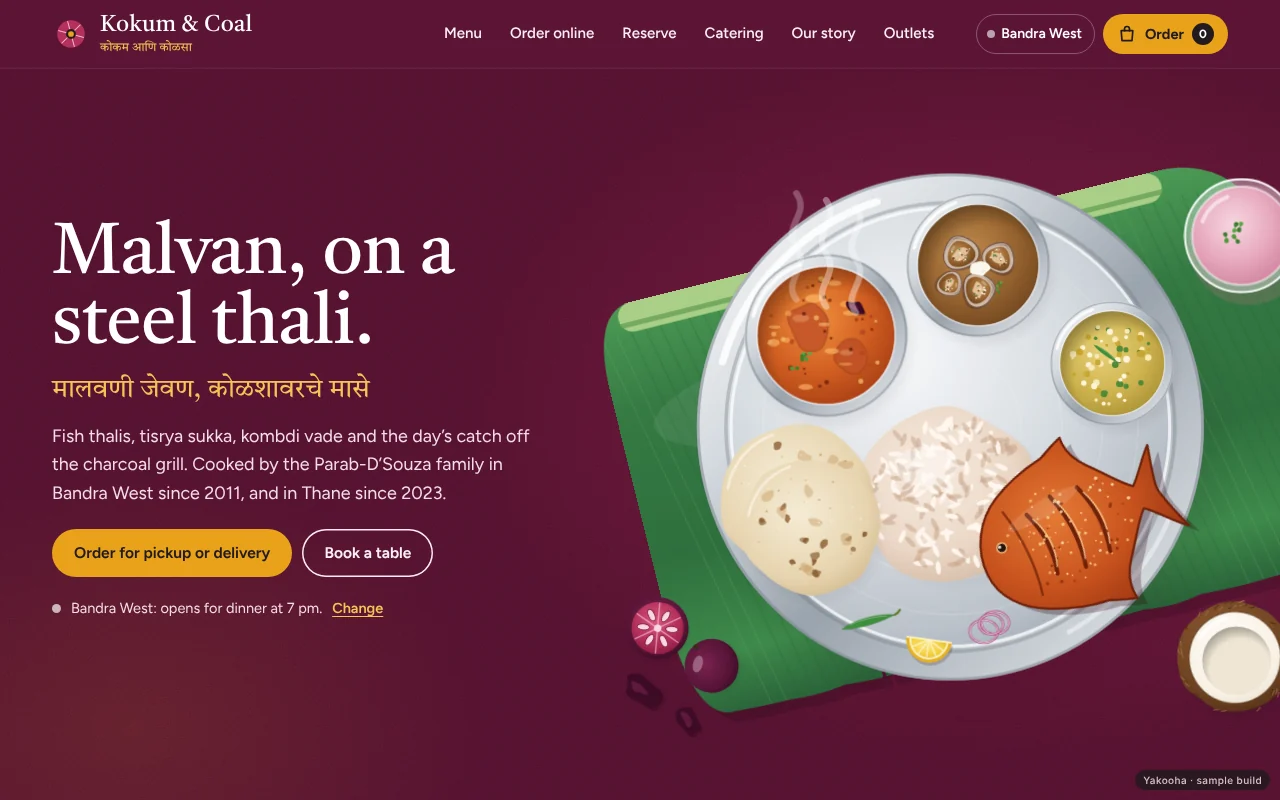
We drew every plate ourselves in one overhead style, steel thalis and banana leaf on kokum, and set the type in a face that carries both English and Marathi, so the dish names can sit in the script the kitchen uses.
- One illustrated thali as the first screen, assembling as the page loads
- Outlet choice drives menu, prices, delivery area and bookings
- Market price handled with sizes, preparations and time-of-day status
- WhatsApp used for confirmations and tracking, not marketing
- Bilingual dish names in English and Marathi
What shipped
- Browse a menu with veg, non-veg, egg and Jain markers, spice levels, allergens, search and filters
- Switch between Bandra and Thane and watch prices and availability change, cart included
- Order the catch of the day by size and cooking style at market price, from a board that changes through the day
- Customise a thali: rice or bhakri, gravy level, spice, add-ons
- Check delivery by pincode, pick a slot, apply a coupon and see a bill with CGST and SGST at 2.5% each
- Pay through a Razorpay-style checkout with UPI, card, netbanking or pay on delivery
- Track an order from accepted to delivered with simulated WhatsApp updates and download a GST invoice
- Book a table by outlet, day, meal, time, party size, seating and occasion, add it to your calendar, then change or cancel it
- Get a live per-head estimate for private dining or office tiffins and send an enquiry
- Buy and send a gift card, and apply for a job
Under the surface
How it is built
In production we'd build this on Next.js with the menu, specials and catch board in a headless CMS that the kitchen updates from a phone each morning. Orders would go straight into the restaurant's POS through its integration API so the kitchen works from one screen, payments through Razorpay with UPI intent on mobile, delivery dispatched to the restaurant's own riders or a partner like Porter, and every status change pushed to the customer through the WhatsApp Business API.
- Menu and prices modelled per outlet, with day-of-week and sell-out rules
- Bill computed server-side with CGST and SGST and a downloadable tax invoice
- Delivery eligibility by pincode and distance from each kitchen
- Reservations with slot inventory per outlet, meal and seating
- Calendar invites and booking changes without a login
Considered and turned down
We considered embedding a white-label ordering widget from a POS vendor. We turned it down because it couldn't show market-priced fish or thali customisations well, and it would have looked like everyone else's widget instead of this restaurant.