Website for clinics & health
Kshitij Family Clinic
A website and booking flow for a family polyclinic
Kshitij Family Clinic is a sample brief. We imagined a seven-speciality family clinic in Thane West, where most appointments are booked by a son or daughter on a phone, and asked ourselves what its website should do for them. The clinic is imaginary. The website isn't: we designed and engineered it, and you can use it right now, below.
- IndustryClinics & health
- Year2026
- Runs onWeb
- DisciplineWebsites & web apps
- Built aroundABDM (ABHA), WhatsApp Business API, UPI, Razorpay, DLT-registered SMS
A sample brief, a real product. We wrote this brief ourselves. The business is imaginary; the product is not: we designed and engineered it, and you can use it below. We publish results only for work a client has let us verify, so this page shows none.
The brief
We imagined Kshitij as a family clinic on the first two floors of a building in Naupada, a short walk from Thane station. Family medicine, paediatrics, gynaecology, ENT, dermatology, physiotherapy and a pathology lab share one front desk. Eleven doctors and physiotherapists sit in morning and evening sessions on different days, and the lab opens at 7 for fasting samples.
The people we pictured visiting the site are families from across Thane: parents of small children, working adults coming in after the train home, and above all sons and daughters booking for an ageing parent from their own phone. They want to know who sits when, what a check-up costs, where to park, and whether the report will reach them without another trip.
- Seven specialities and an in-house lab under one roof
- Eleven doctors, each with their own OPD days and sessions
- Many bookings made by an adult child for a parent
- Visitors of every age, mostly on a phone
The problem
A clinic like this usually runs its timetable on a printed board and a receptionist's memory. Families call to ask whether a doctor is in today, wait on hold, and turn up to find the session has moved. Reports are collected in person from a counter, and the person who booked often isn't the person who gets the update.
Health websites tend to fall at one of two extremes: a brochure with a phone number, or a hospital portal that asks for an account before showing a single timing. Neither helps someone in a hurry on a phone, and neither treats health data with the care India's data protection law now expects.
- Timetables live on a board, not online
- The booker and the patient are often different people
- Reports mean a second trip to the clinic
- Consent for health data is usually an afterthought
The approach
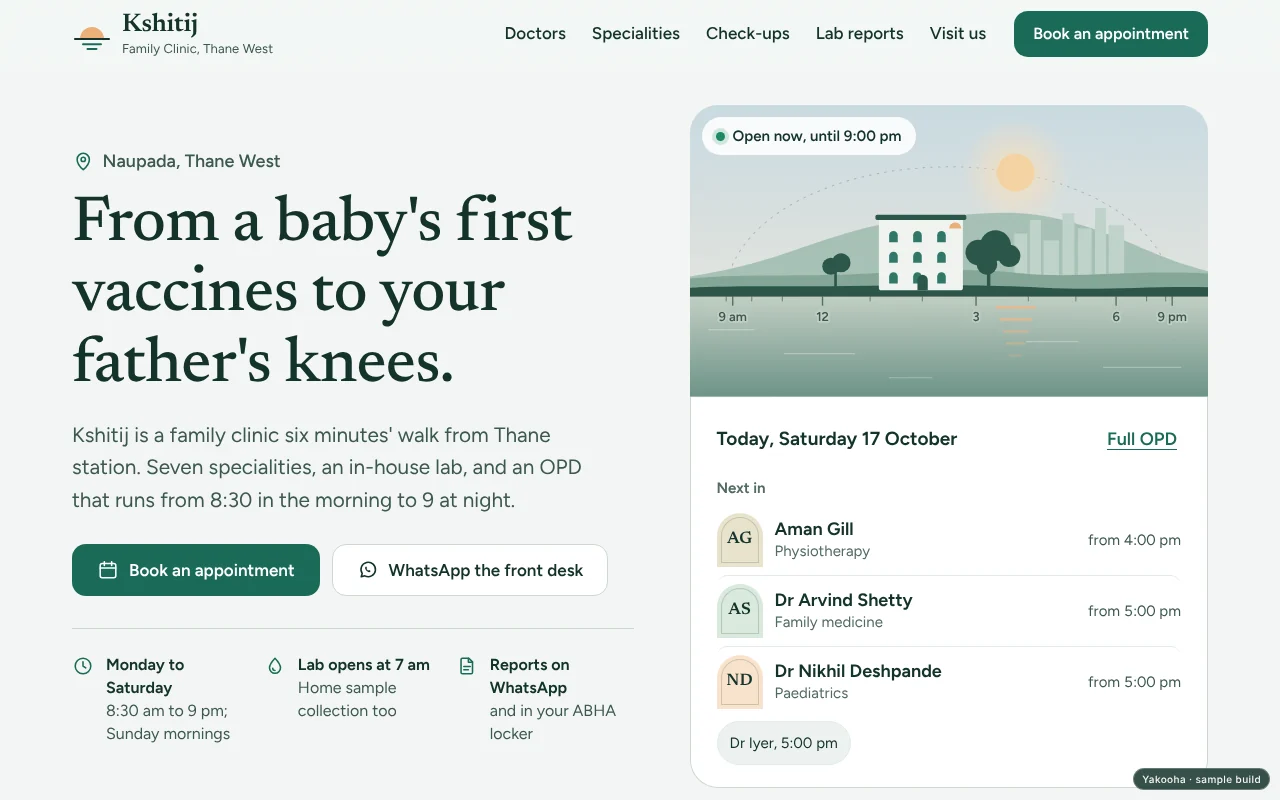
We made the timetable the centre of the site. Kshitij means horizon, so the first screen is a drawn horizon over Masunda lake, with the sun placed at the current time in the clinic's day and the doctors who are in right now listed beneath it. Every OPD view, from the home page to each doctor's profile, is computed from the same timetable in IST, so the answer to who sits when is always the same.
Booking separates the patient from the person booking, so a daughter can book for her mother and receive the WhatsApp updates herself. Consent is written in plain words, separately from optional reminders, with a guardian line for children. Type is large and calm, touch targets are generous, and every page carries the same note: this is not an emergency facility, call 112.
- A live horizon that marks the clinic day
- One timetable drives every OPD view
- Booking for yourself or for a family member
- Consent written per the DPDP Act, not a buried checkbox
- Large type and big targets for older visitors
What shipped
- See which doctors are in right now, worked out from the timetable and the current time in IST
- Watch the sun move across a drawn horizon that marks the clinic day, from 8 am to 9 pm
- Filter eleven doctors by speciality, day, time of day and the language they speak
- Book a slot in the next 14 days for yourself or a parent, with ABHA validation and plain-language consent
- Get a token number, a calendar file and a sample WhatsApp confirmation
- Find a booking by ID and mobile number, then move it or cancel it
- Book a check-up at the lab or at home, with a pincode check and a sample UPI, card or netbanking checkout
- Open a sample lab report with a one-time code, download it, or save it to an ABHA locker
- Read five short articles, each reviewed by a named doctor and marked as general information
- Find the clinic on an illustrated map with parking, step-free access and an emergency note
Under the surface
How it is built
The production site would be a Next.js front end reading doctors, sessions, leave and holidays from Sanity, so the front desk can change a timetable without a developer. Slots and bookings would live in a small Node.js service on PostgreSQL, which owns token numbers, holds and cancellations. Confirmations and report links would go out through the WhatsApp Business API via an Indian BSP, with DLT-registered SMS as a fallback, and lab reports would be linked to patients' ABHA through the ABDM gateway. Check-up payments would run through Razorpay, and everything would be hosted in AWS's Mumbai region to keep health data in India.
- Timetable, leave and holidays edited by the front desk in the CMS
- Booking service owns slots and tokens, with a short hold while a patient fills in details
- WhatsApp templates for confirmation, reschedule, cancellation and report-ready messages
- Report links that open with a one-time code and expire after seven days
- Consent records stored per purpose, so withdrawal is exact
Considered and turned down
We considered embedding a third-party clinic booking widget, which would have been quicker to set up. We turned it down because it would split the timetable from the rest of the site, send families to another brand mid-booking, and put health data with a provider the clinic doesn't control.