Portfolio for portfolios
Nila Works
A portfolio and print shop for an illustrator
Nila Works is a sample brief. We imagined a one-person illustration and brand design studio in Bengaluru whose work kept getting lost in a grid of Instagram squares, and asked ourselves what we'd build for her. The studio is imaginary. The site isn't: we designed and engineered it, drew every picture on it, and you can use it right now, below.
- IndustryPortfolios
- Year2026
- Runs onWeb
- DisciplineWebsites & web apps
- Built aroundRazorpay, UPI, India Post Speed Post, WhatsApp Business API, GST invoicing
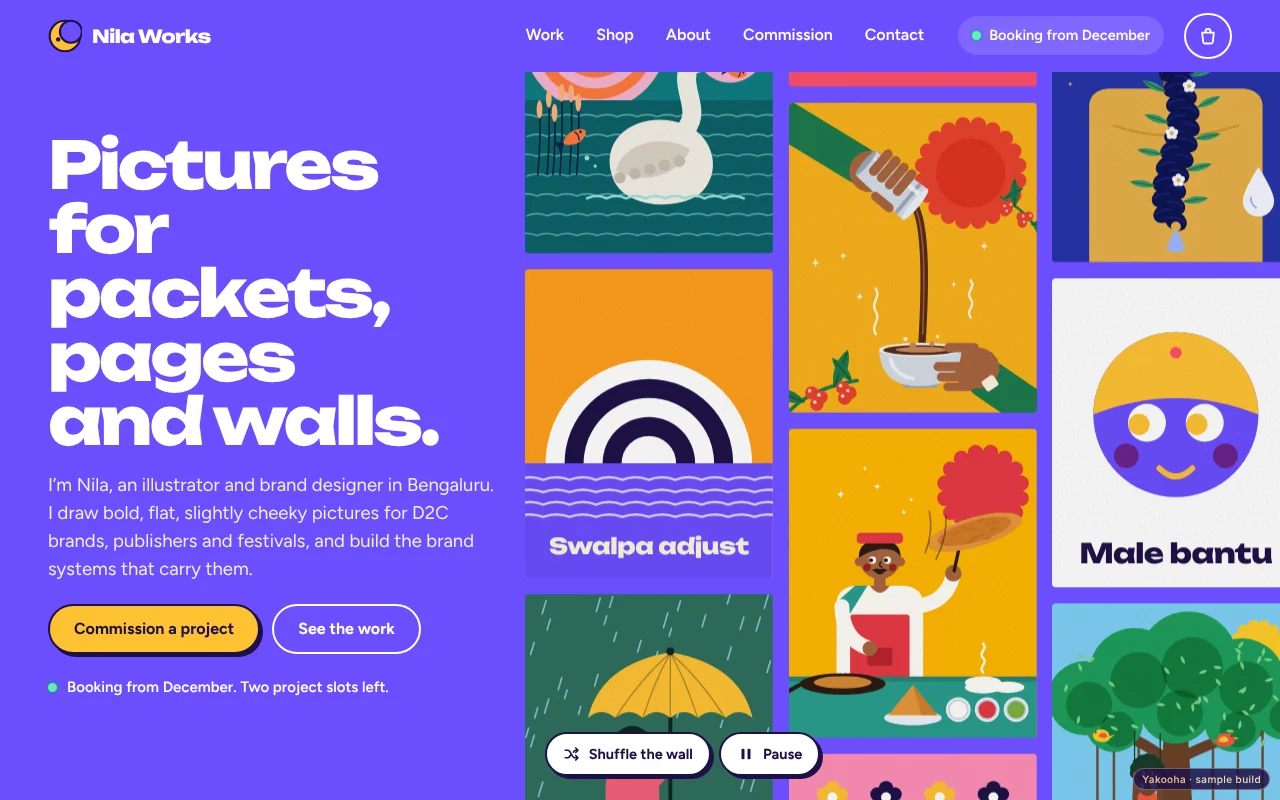
A sample brief, a real product. We wrote this brief ourselves. The business is imaginary; the product is not: we designed and engineered it, and you can use it below. We publish results only for work a client has let us verify, so this page shows none.
The brief
We imagined Nila, an independent illustrator and brand designer working alone from a desk in Basavanagudi. Her clients are brand managers at Indian D2C food and beauty brands, editors at small presses, festival teams and agencies who need a recognisable hand for packaging, books, posters and walls.
She also sells a few limited-edition prints of her own drawings, mostly about Bengaluru, to people who found her through a pack or a poster.
- One person, roughly eight commissions a year
- Five kinds of work: illustration, identity, packaging, editorial, murals
- GST-registered in Karnataka, invoicing in rupees
- Limited print editions shipped anywhere in India
The problem
Illustrators usually show their work as a grid of finished images. A brand manager scanning that grid can see the style but not the thinking: how a sketch became a pack, whether the drawing survives as a 200-pixel tile on a delivery app, what the team actually gets in its kit.
The practical questions sit elsewhere, if anywhere: what it costs, when she is free, who owns the drawings, whether there will be a GST invoice. And the print shop is often a separate store that feels like someone else's site.
- Finished images hide the process clients are paying for
- Rates, licensing and availability are rarely written down
- Print sales and shipping costs vary wildly by pincode
- An artist's site can easily look like a SaaS template
The approach
We decided the work itself should be the opening moment, so the home page is a drifting wall of her posters whose characters follow your pointer. Every picture on the site, from covers to coffee pouches to beer labels, is drawn by one small illustration engine, which keeps a single recognisable hand across twelve very different clients.
Each case study is data-driven and walks the same path a client would: the brief, a pencil sketch you can wipe into the final artwork, the colour, type and motif system, and the artwork in use. Booking and buying sit one click away, with rates, availability and GST spelled out.
- A violet and turmeric palette taken from jacaranda season and Channapatna lacquer toys
- Rounded, wide display type that echoes the circles and pills in her drawings
- Sketch and final rendered from the same shapes, so the comparison is honest
- A commission form that estimates a fee range as you fill it in
- Shipping quoted from the pincode, not a flat guess
What shipped
- A live wall of posters on the home page whose characters watch your pointer, with shuffle and pause
- Twelve case studies, each with a pencil sketch and final artwork you can wipe between
- A colour, type and motif system plus packaging, poster and social mock-ups for every project, all drawn in code
- Work filtered by illustration, brand identity, packaging, editorial and murals, as posters or a list
- Limited art prints in A3 or A2 on three papers, previewed at scale on a wall
- Delivery dates and India Post or courier rates worked out from any pincode
- A simulated Razorpay checkout with UPI QR, UPI apps, cards and netbanking, plus an optional GSTIN
- Order tracking, a downloadable receipt and WhatsApp update hand-off
- A commission form with a live fee estimate in rupees, an intro-call picker and a calendar file
Under the surface
How it is built
In production this would be a Next.js site with projects, prints and rates edited in Sanity, so Nila can add a case study by filling in a brief, picking colours and uploading her own sketch and final files. Prints would sell through Razorpay Payment Links or Shopify Lite with Shiprocket rates for courier and India Post, enquiries would land in her inbox and a WhatsApp Business template, and the whole thing would deploy on Vercel.
- One content model for projects drives the index, filters, case pages and home wall
- Sketch and final artwork share a single comparison component
- Pincode lookup decides zone, courier rate, India Post rate and delivery window
- GSTIN captured at checkout and printed on the invoice
- Images served as optimised SVG and WebP with no third-party trackers
Considered and turned down
We considered a hosted portfolio platform with a bolted-on store, but it would have forced her work into identical tiles and pushed the print shop and booking terms onto separate sites.